etamu.id – Writing great content takes time. Whether you are a blogger preparing your next article, a student working on an assignment, a marketer developing a campaign, or a professional writer creating content for clients, the process involves much more than putting words on a page.
You need to find reliable information, organize your ideas, write clear sentences, check grammar, improve readability, and make sure your content reaches the right audience.
Fortunately, AI writing tools have made many of these tasks easier.
In 2026, AI-powered writing assistants can help users brainstorm topics, create article outlines, summarize research, improve grammar, rewrite sentences, and prepare SEO-friendly content. Some platforms are designed for general writing, while others focus on marketing, academic assistance, editing, or search engine optimization.
But which tools are actually worth trying?
In this guide, we explore the 15 best AI writing tools in 2026 for bloggers, students, writers, and creators. You will learn what each platform does, who should use it, and how to choose the right solution without sacrificing accuracy or originality.
Whether you want to write faster, improve your English, create better blog posts, or organize your content workflow, this list will help you find a suitable AI writing assistant.
What Are AI Writing Tools?
AI writing tools are applications that use artificial intelligence to help people create, edit, organize, and improve written content.
Most modern AI writing platforms use large language models (LLMs) to understand instructions and generate responses based on the context provided by the user.
Depending on the application, these tools can help with:
- Writing blog posts and website articles.
- Creating social media captions.
- Generating marketing emails and advertising copy.
- Developing essays and study notes.
- Checking spelling and grammar.
- Rewriting sentences for better clarity.
- Creating SEO content outlines.
- Summarizing research documents.
- Generating headlines and content ideas.
For example, a blogger can ask an AI assistant to create an outline for an article about productivity apps. A student can use an AI tool to explain a difficult concept, while a marketer can develop several versions of an advertising headline.
The main advantage is efficiency. Instead of starting every writing project from a blank page, users can use AI to build a first draft and then improve it.
However, AI-generated text still requires human review. AI can misunderstand instructions, produce incorrect information, or create sentences that sound repetitive and generic.
15 Best AI Writing Tools in 2026
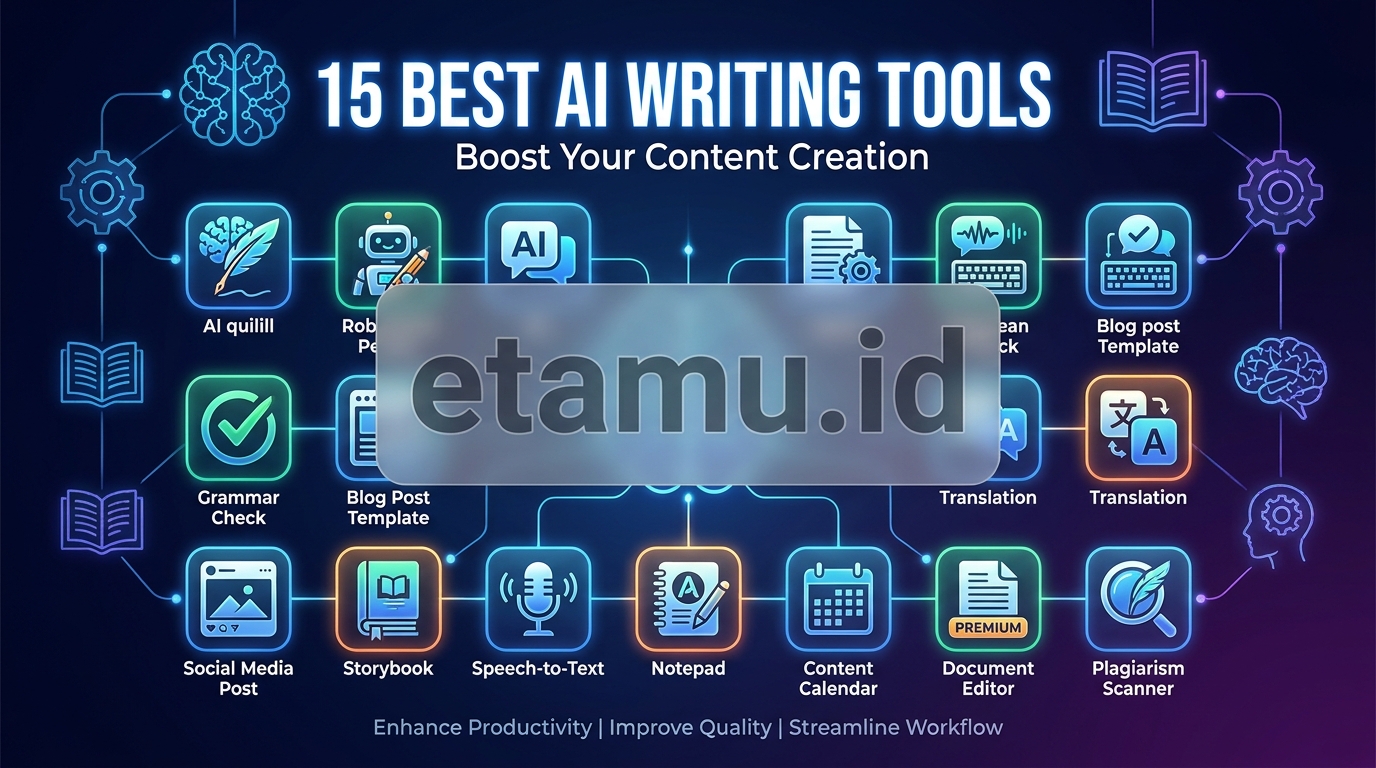
The following tools cover different writing needs, including general AI writing, editing, grammar, research, and SEO content optimization.
1. ChatGPT – Best Overall AI Writing Assistant
ChatGPT is one of the most versatile AI writing assistants available in 2026.
It can help users move from an initial idea to a structured piece of content. You can use it to brainstorm topics, create article outlines, write first drafts, improve paragraphs, generate headlines, and summarize information.
For bloggers, ChatGPT can help develop SEO article structures and frequently asked questions. Students can use it to understand complicated subjects, while marketers can create campaign ideas, product descriptions, and email drafts.
Key features and uses:
- Blog post and article drafting.
- Content ideas and brainstorming.
- Rewriting and summarizing.
- Email and marketing copy.
- Script and social media caption writing.
- Explaining complex topics.
Why choose it?
Its flexibility makes it a practical starting point for almost any writing task. You can also provide additional instructions to adjust the tone, audience, structure, and length of the output.
Best for: Bloggers, students, marketers, freelancers, and general content creators.
Website: https://chatgpt.com/
2. Claude – Best for Long-Form Writing
Claude, developed by Anthropic, is an AI assistant that is particularly useful for working with detailed documents and longer writing projects.
It can help users develop structured articles, improve paragraphs, analyze source material, and organize complex ideas.
For writers who regularly produce long-form content, Claude can be useful during both the drafting and revision stages.
You can provide a draft and ask it to identify unclear explanations, repetitive sections, or weaknesses in the overall structure.
Key features and uses:
- Long-form article drafting.
- Document analysis and summarization.
- Creative writing assistance.
- Editing and rewriting.
- Organizing complex information.
Why choose it?
Claude is a strong option when your writing project involves a lot of context or requires careful development across multiple sections.
Best for: Bloggers, professional writers, researchers, and students.
Website: https://claude.ai/
3. Google Gemini – Best for Google Ecosystem Users
Google Gemini is an AI assistant that can support writing, brainstorming, research, and everyday productivity.
It is particularly interesting for people who already use Google’s digital ecosystem.
Depending on the available features and connected applications, Gemini can help users develop content ideas, summarize information, draft emails, and work with documents.
For students, it can be useful when exploring unfamiliar subjects. Bloggers can use it to create outlines, while marketers can brainstorm campaign concepts.
Key features and uses:
- Writing and rewriting assistance.
- Content brainstorming.
- Summarizing information.
- Research support.
- Productivity assistance.
- Working with supported Google services.
Why choose it?
Gemini is worth considering if you already use Google services and want an AI assistant that fits into your existing workflow.
Best for: Students, bloggers, professionals, and Google Workspace users.
Website: https://gemini.google.com/
4. Jasper – Best for Marketing Content
Jasper is an AI writing platform focused on marketing and business content.
Unlike general-purpose AI assistants, Jasper is designed to support marketing workflows, including brand messaging, campaign development, and content production.
Businesses often need to create multiple versions of similar messages while maintaining a consistent brand identity. Jasper can help organize that process.
Key features and uses:
- Marketing copy generation.
- Product descriptions.
- Advertising content.
- Email campaigns.
- Brand voice management.
- Marketing content workflows.
Why choose it?
Jasper is worth exploring if you manage several marketing campaigns or create content for different brands.
It may be more than a casual blogger needs, but its marketing-focused features can be useful for professional teams.
Best for: Marketers, marketing agencies, businesses, and content teams.
Website: https://www.jasper.ai/
5. Copy.ai – Best for Marketing Ideas and Sales Copy
Copy.ai is an AI-powered platform that helps businesses and marketers create written content and support go-to-market workflows.
It can assist with brainstorming, marketing messages, sales-related content, and campaign development.
For example, a marketer could use it to generate several headline variations for a product launch or develop different approaches to an email campaign.
Key features and uses:
- Marketing copy.
- Sales content.
- Product descriptions.
- Email drafts.
- Campaign brainstorming.
- Content workflow support.
Why choose it?
Copy.ai is particularly relevant for people who create marketing and sales content regularly.
Best for: Marketing professionals, sales teams, entrepreneurs, and agencies.
Website: https://www.copy.ai/
6. Writesonic – Best for SEO-Focused Content
Writesonic is an AI content platform that combines writing assistance with SEO-oriented features.
It can help users develop articles, create content ideas, and work on search-focused content projects.
For bloggers, this can be useful when preparing articles around specific search topics. Instead of focusing only on generating paragraphs, users can consider the broader content strategy.
Key features and uses:
- AI article generation.
- SEO content assistance.
- Content outlines.
- Marketing copy.
- Topic development.
- Search-focused content workflows.
Why choose it?
Writesonic is worth considering if your main goal is producing content for websites and digital marketing campaigns.
Remember that AI-generated articles still need original insights, source verification, and proper editing before publication.
Best for: SEO writers, bloggers, publishers, and digital marketers.
Website: https://writesonic.com/
7. Grammarly – Best for Grammar and Writing Clarity
Grammarly is widely used to improve written communication.
Its AI-powered writing features can help users check grammar, spelling, punctuation, tone, and clarity.
For people who write in English as a second language, this type of assistance can be particularly helpful.
For example, a blogger can use Grammarly to review an article before publishing it. A student can check whether an explanation sounds clear, while a professional can polish an email before sending it.
Key features and uses:
- Grammar and spelling checks.
- Punctuation suggestions.
- Writing clarity improvements.
- Tone adjustments.
- Sentence suggestions.
- Writing assistance across supported applications.
Why choose it?
Grammarly is especially useful during the editing stage. It helps improve the quality of an existing draft rather than simply generating a new article.
Best for: Students, bloggers, professionals, and English-language writers.
Website: https://www.grammarly.com/
8. ProWritingAid – Best for Detailed Writing Improvement
ProWritingAid is a writing assistant designed to help users improve grammar, style, readability, and overall writing quality.
It offers more detailed writing analysis than a basic spell checker.
For example, fiction writers can review sentence structure and repeated words, while bloggers can identify sections that may be difficult to read.
Key features and uses:
- Grammar checking.
- Style and readability analysis.
- Repeated word detection.
- Sentence structure suggestions.
- Writing reports.
- Manuscript editing assistance.
Why choose it?
ProWritingAid is useful when you want to improve not just individual grammar mistakes but the overall quality of your writing.
Best for: Authors, bloggers, editors, and long-form writers.
Website: https://prowritingaid.com/
9. QuillBot – Best for Paraphrasing and Summarizing
QuillBot is known for its paraphrasing and text improvement features.
It can help users rewrite sentences, summarize longer passages, and explore different ways to express an idea.
For example, if a sentence sounds repetitive, you can use QuillBot to generate an alternative version and then decide whether it fits your writing style.
Key features and uses:
- Paraphrasing.
- Text summarization.
- Grammar checking.
- Vocabulary suggestions.
- Sentence restructuring.
- Translation and writing assistance in supported languages.
Why choose it?
QuillBot is useful when you already have written material and want to improve its clarity or explore alternative wording.
However, paraphrasing should never be used to disguise copied work. Always cite original sources when you use someone else’s research or ideas.
Best for: Students, bloggers, researchers, and English-language writers.
Website: https://quillbot.com/
10. Wordtune – Best for Rewriting Sentences Naturally
Wordtune is an AI writing assistant focused on helping users express ideas more clearly.
It can suggest alternative sentence structures, adjust tone, and help make written communication more natural.
For example, you might have a paragraph that sounds too formal for a blog audience. Wordtune can help explore a more conversational version.
Key features and uses:
- Sentence rewriting.
- Tone adjustment.
- Text summarization.
- Clarity improvements.
- Alternative wording suggestions.
Why choose it?
Wordtune can be useful when you know what you want to say but are not satisfied with the way your sentences sound.
Best for: Bloggers, students, professionals, and content editors.
Website: https://www.wordtune.com/
11. Notion AI – Best for Writing and Organizing Projects
Notion is a productivity and workspace platform that combines notes, documents, databases, and project management.
Its AI features can help users summarize notes, improve drafts, generate content ideas, and organize information.
For bloggers, Notion can become a central location for article ideas, editorial calendars, research notes, and draft management.
Students can use it to organize class notes and study materials, while marketing teams can manage campaign documentation.
Key features and uses:
- Note summarization.
- Draft improvement.
- Content planning.
- Information organization.
- Project documentation.
- Collaborative writing workflows.
Why choose it?
Notion AI is particularly useful if you want writing assistance inside a larger productivity workspace.
Best for: Bloggers, students, freelancers, and content teams.
Website: https://www.notion.com/product/ai
12. Perplexity – Best for AI Research and Source Discovery
Good writing often starts with good research.
Perplexity is an AI-powered research and search platform that helps users explore topics and discover relevant sources.
Instead of simply asking an AI writer to produce an article, you can use a research assistant to investigate the subject first.
For example, a technology blogger could explore recent developments in artificial intelligence, identify useful references, and use those findings as the foundation for an article.
Key features and uses:
- Topic research.
- Source discovery.
- Research summaries.
- Follow-up questions.
- Comparing information.
- Exploring current developments.
Why choose it?
Perplexity is useful when research and source discovery are important parts of your writing process.
Always open the original sources and verify important claims. An AI-generated summary is not a replacement for checking the evidence.
Best for: Bloggers, students, journalists, and researchers.
Website: https://www.perplexity.ai/
13. Surfer SEO – Best for SEO Content Optimization
Surfer SEO is a content optimization platform designed to help website owners and writers improve search-focused articles.
It provides tools for analyzing content and developing optimization recommendations around a target topic.
For bloggers, this can help identify relevant subtopics and improve how an article covers a subject.
Key features and uses:
- SEO content optimization.
- Topic and keyword analysis.
- Content editor.
- Article planning.
- Search-focused recommendations.
- Content auditing features.
Why choose it?
Surfer SEO is worth considering if you regularly publish articles and want a more structured approach to on-page content optimization.
However, following optimization suggestions mechanically does not guarantee higher rankings. The article still needs to answer the reader’s question better than competing content.
Best for: SEO specialists, bloggers, publishers, and content agencies.
Website: https://surferseo.com/
14. Frase – Best for Content Research and SEO Briefs
Frase combines content research and writing assistance to support SEO-focused publishing.
It can help users explore search topics, prepare article briefs, and organize content around relevant questions and subtopics.
This is particularly useful when writing articles that need to cover a subject comprehensively.
For example, before writing a guide about AI productivity software, a blogger can use Frase to organize the main sections and identify related questions worth answering.
Key features and uses:
- Content research.
- SEO article briefs.
- Topic exploration.
- Content optimization.
- AI writing assistance.
- Question and subtopic discovery.
Why choose it?
Frase is useful when your writing workflow involves both research and search-focused content planning.
Best for: SEO bloggers, content strategists, and digital publishers.
Website: https://www.frase.io/
15. Rytr – Best for Simple and Quick AI Writing
Rytr is an AI writing assistant designed to help users create shorter pieces of content without a complicated workflow.
It can be useful for generating ideas, drafting marketing messages, and creating everyday written material.
For example, a small business owner might use Rytr to prepare product descriptions, while a social media manager could develop several caption ideas.
Key features and uses:
- Short-form content generation.
- Email drafts.
- Product descriptions.
- Social media captions.
- Writing ideas.
- Rewriting assistance.
Why choose it?
Rytr is worth exploring if you need a straightforward AI writing assistant for everyday content tasks.
Best for: Beginners, freelancers, small businesses, and social media writers.
Website: https://rytr.me/
Quick Comparison: Which AI Writing Tool Should You Choose?
Choosing the right platform becomes easier when you compare tools based on their main purpose.
| AI Tool | Best Use | Ideal User |
|---|---|---|
| ChatGPT | General writing and brainstorming | Everyone |
| Claude | Long-form writing | Bloggers and writers |
| Google Gemini | Writing and productivity | Students and professionals |
| Jasper | Marketing content | Marketing teams |
| Copy.ai | Sales and marketing copy | Businesses |
| Writesonic | SEO-focused writing | Bloggers |
| Grammarly | Grammar and clarity | Students and writers |
| ProWritingAid | Detailed editing | Authors and editors |
| QuillBot | Paraphrasing and summaries | Students and bloggers |
| Wordtune | Sentence rewriting | Professionals |
| Notion AI | Writing and organization | Teams and bloggers |
| Perplexity | Research and sources | Researchers |
| Surfer SEO | Content optimization | SEO specialists |
| Frase | SEO research and briefs | Content strategists |
| Rytr | Quick content drafts | Beginners |
There is no single tool that is best for everyone. The right choice depends on what you write, how often you publish, and which part of the writing process takes the most time.
How to Use AI Writing Tools Without Losing Originality

AI writing tools can save time, but relying on them too heavily can make your content sound generic.
If every article follows the same structure, uses similar phrases, and repeats information already available elsewhere, readers have little reason to choose your website.
Here are some practical ways to use AI while maintaining originality.
1. Start With Your Own Ideas
Before asking AI to write an article, decide what you want readers to learn.
Your experience, opinions, and understanding of the topic should guide the content.
Use AI to develop your ideas, not replace the thinking behind them.
2. Provide Clear Instructions
The quality of AI output often depends on the instructions you provide.
Instead of asking:
“Write an article about AI tools.”
Try a more specific prompt:
“Create a beginner-friendly article outline about AI writing tools for bloggers. Explain the main use cases, compare different tool categories, and include practical examples. Use a natural, conversational tone.”
Clear instructions help the AI understand the audience and purpose of the content.
3. Verify Important Information
AI systems can generate incorrect facts, outdated product information, or references that do not support the claims being made.
Always check important details using reliable sources, particularly when writing about:
- Product features.
- Software pricing.
- Legal or academic information.
- Medical or financial topics.
- Recent news and developments.
- Statistics and research findings.
4. Add Original Examples and Insights
A good article should offer something beyond a collection of AI-generated paragraphs.
Include your own examples, comparisons, experiences, screenshots, and practical recommendations whenever possible.
This makes your content more useful and gives readers a reason to trust your website.
5. Edit the Final Draft
Read the entire article before publishing it.
Remove repetitive sentences, improve transitions, check the facts, and make sure the writing sounds natural.
AI can help create a draft, but the final editorial decisions should remain yours.
Are AI Writing Tools Good for SEO?
Yes, AI writing tools can support SEO when they are used correctly.
They can help with keyword brainstorming, article outlines, related search questions, content structure, title variations, and editing.
For example, a blogger targeting the keyword “best AI writing tools” could use AI to identify useful supporting topics such as grammar checking, AI research, paraphrasing, and SEO optimization.
However, using AI does not automatically make an article rank higher on Google.
Google’s guidance focuses on helpful, reliable, people-first content. It emphasizes originality, accuracy, and meaningful value rather than simply producing content with AI or targeting a specific word count.
Google also warns that generating many pages with AI without adding value may fall under its scaled content abuse policies.
For better SEO results, focus on:
- Matching the reader’s search intent.
- Providing accurate and useful information.
- Using relevant keywords naturally.
- Organizing content with descriptive headings.
- Adding original examples and insights.
- Linking to relevant internal resources.
- Reviewing and updating outdated information.
In other words, use AI to improve your writing process, not to manufacture low-quality pages.
Limitations of AI Writing Tools You Should Know
Although AI writing software offers many benefits, it is not perfect.
Understanding its limitations helps you use these tools more responsibly.
1. AI Can Produce Incorrect Information
AI-generated answers may sound confident even when the information is inaccurate.
This is why fact-checking is essential.
2. Writing Can Sound Repetitive
Some AI-generated content uses predictable phrases, generic introductions, and repeated conclusions.
Human editing helps make the writing more natural and engaging.
3. AI May Miss Context
An AI tool might misunderstand your audience, industry, or intended message.
Provide background information and review the output carefully.
4. Originality Still Requires Human Input
AI can combine existing patterns and ideas, but meaningful original insight often comes from personal experience, expertise, and independent thinking.
5. Privacy and Copyright Need Attention
Avoid entering confidential client information, private documents, or sensitive personal data into AI platforms unless you understand the provider’s data policies.
Also review licensing conditions before using generated content commercially.
Frequently Asked Questions About AI Writing Tools
What is the best AI writing tool in 2026?
ChatGPT is a strong all-round option for brainstorming, drafting, rewriting, and general writing assistance. Claude is another useful choice for long-form writing, while Grammarly is particularly helpful for editing and improving grammar.
The best option depends on your specific needs.
What is the best free AI writing tool?
Several platforms offer free access or limited free plans, including ChatGPT, Google Gemini, Grammarly, and QuillBot. Features and usage limits vary, so check each provider’s current plan before choosing.
Can AI writing tools write a complete blog post?
Yes. Many AI assistants can generate complete blog post drafts from detailed instructions.
However, you should review the structure, verify factual claims, add original insights, and edit the text before publishing.
Are AI writing tools good for students?
Yes. Students can use AI tools to understand difficult subjects, organize notes, brainstorm essay ideas, summarize reading materials, and improve grammar.
They should still follow their institution’s academic integrity rules and avoid submitting AI-generated work as their own when that is not permitted.
Which AI writing tool is best for SEO?
Writesonic, Surfer SEO, and Frase are useful options for SEO-focused content workflows. ChatGPT and Claude can also help with keyword-related brainstorming and article outlines.
Remember that no AI tool can guarantee search rankings.
Can AI writing tools improve English grammar?
Yes. Tools such as Grammarly, ProWritingAid, and QuillBot can help identify grammar issues, improve sentence clarity, and suggest alternative wording.
They are particularly useful for people who regularly write in English as a second language.
Is AI-generated content allowed on Google?
Google does not automatically prohibit content simply because AI was involved in its creation. Its guidance emphasizes accuracy, quality, originality, and usefulness.
Publishing large amounts of low-value content created primarily to manipulate search rankings can violate Google’s spam policies.
Can AI writing tools replace human writers?
AI can automate some writing tasks, but it does not completely replace human creativity, judgment, experience, and subject knowledge.
Human writers remain important for producing original perspectives, checking facts, developing stories, and understanding audience needs.
How many AI writing tools should I use?
You do not need all 15 tools. Start with one general writing assistant and one editing tool. Add research or SEO software when your workflow requires it.
A smaller, well-organized toolkit is often more useful than paying for several applications that perform similar tasks.
Explore More AI Guides on etamu.id
If you want to discover more ways to use artificial intelligence for writing, content production, and productivity, explore these related guides:
- Best AI Tools for Content Creators – Discover useful AI applications for writing, image generation, video production, audio, and social media workflows.
- 30 Best Free AI Tools in 2026 – Explore AI tools that can help with everyday tasks without immediately paying for a subscription.
- 15 Best AI Image Generators – Find AI image tools for creating illustrations, blog graphics, thumbnails, and digital artwork.
- 25 Best AI Tools to Try in 2026 – Explore a broader collection of AI tools for work, content creation, and productivity.
Final Thoughts: Choose AI Writing Tools That Actually Help You
The best AI writing tools in 2026 are not necessarily the ones with the longest feature lists. They are the tools that make your writing process easier while helping you produce useful, accurate, and engaging content.
If you are a blogger, start with an AI writing assistant and an SEO tool. If you are a student, focus on research, explanation, and grammar support. If you are a marketer, consider platforms that help maintain brand consistency and produce campaign content.
Most importantly, do not let AI take away your original voice.
Use it to brainstorm faster, organize ideas, improve sentences, and handle repetitive tasks. Then bring your own knowledge, experience, and creativity into the final result.
The goal is not simply to write more content. It is to create better content that people genuinely want to read.
Stay connected with etamu.id for more practical guides on AI tools, digital productivity, content creation, and the latest technology trends.

- 15 Best AI Writing Tools in 2026 for Bloggers, Students & Creators - November 9, 2026
- Snapchat Mengumumkan Fitur AR Baru di Acara Lens Fest 2024 - November 9, 2026
- Best Credit Score Improvement Tools - November 8, 2026